Grooves, Color, and Community: How Gen Z Fell Hard for the Record Store
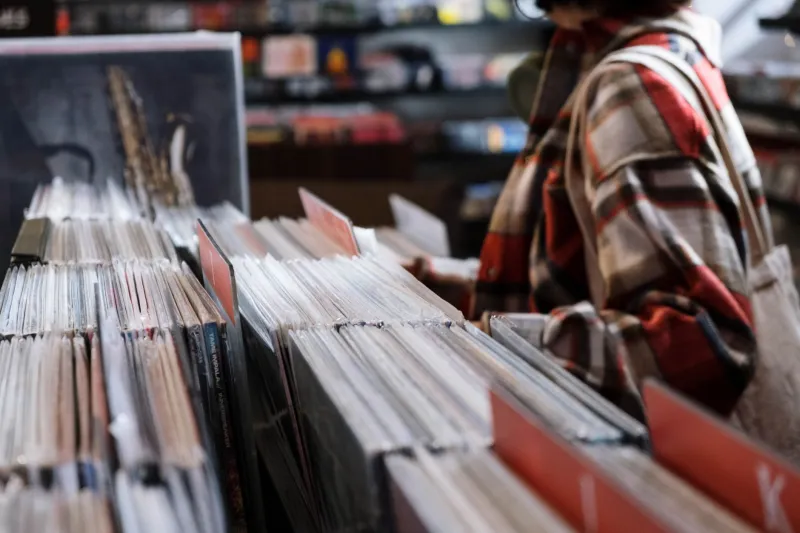
There's a moment that happens in every record store worth its salt. You're flipping through a crate, fingers moving fast, and then — you stop. Something catches your eye. Maybe it's a gatefold sleeve with art that looks like it belongs in a gallery. Maybe it's a translucent blue pressing that practically glows under the shop lights. Whatever it is, you pick it up, and suddenly you're not just a music fan. You're a collector, a devotee, a person who commits.
That moment is happening more and more often — and the people experiencing it are younger than you might expect.
The Numbers Don't Lie (And Neither Does Your Record Shelf)
Vinyl sales in the US have now outpaced CD sales for two consecutive years, a milestone nobody predicted when streaming platforms started hoovering up listeners in the early 2010s. The Recording Industry Association of America has tracked steady vinyl growth for over a decade, but what's shifted recently is who's buying. It's not just the audiophile dad hunting down a mint pressing of Rumours. It's the 22-year-old who discovered Phoebe Bridgers through a TikTok rabbit hole and immediately wanted something more than a playlist.
Gen Z's relationship with music has always been layered. They're digital natives who somehow crave analog texture. They've grown up with infinite access and developed a hunger for scarcity. Streaming handed them the whole catalog; vinyl hands them an object.
Why Physical Feels Different Now
There's a ritual to playing a record that streaming simply cannot replicate. You pull the sleeve out, slide the disc free, lower the needle. You sit with it. The experience has a beginning, a side A, a moment where you physically have to get up and flip the thing over. That interruption — which should feel like a flaw — turns out to be a feature. It asks something of you. It slows you down in a way that feels almost countercultural in 2024.
For younger fans who have spent their entire listening lives inside algorithm-fed queues, that deliberateness hits different. It's not nostalgia exactly, because most of them weren't alive for vinyl's first run. It's more like discovering a technology that was built for the way they want to feel about music, even if they never knew they wanted it.
And then there's the artwork. Streaming thumbnails are tiny. Vinyl sleeves are twelve inches of creative real estate. Indie artists and their designers have responded accordingly — treating the album cover, the inner sleeve, the lyric insert as extensions of the record itself. When a fan buys a physical copy, they're buying the whole visual world the band built around the music.
Limited Pressings and the Art of the Drop
Indie labels and self-releasing artists have gotten genuinely clever about how they package all of this. The limited-edition colored vinyl variant has become one of the most effective tools in the modern band's merch strategy — and it works because it borrows the same scarcity logic that drives sneaker culture and streetwear.
A standard black pressing might stay in print indefinitely. But a translucent red variant, limited to 500 copies, sold exclusively through an artist's own site during a 48-hour window? That's a different animal entirely. Fans who grab one aren't just buying a record — they're buying a timestamp, proof that they were paying attention at the right moment. Those copies show up in Instagram posts, get displayed on shelves, become conversation starters.
Bands like Turnover, Julien Baker, and illuminati hotties have all leaned into this model with real success. The result is a revenue stream that doesn't depend on streaming royalties — which, for independent artists, remain infuriatingly thin — and creates a direct financial relationship between the band and the people who care most about them.
Record Store Day and the Pilgrimage Mentality
Record Store Day, which happens every April and again in the fall, has become something close to a secular holiday for younger vinyl fans. The lines outside shops like Amoeba in LA, Reckless Records in Chicago, or Bull Moose in the Northeast start forming embarrassingly early. People bring coffee, make friends in line, treat the whole thing like a concert experience.
That communal dimension matters. Buying a record at a physical store, from a person who knows the catalog and can recommend something you didn't know you needed, is a fundamentally social act. It connects you to a local scene, to a physical place, to other people who show up for the same reasons. In a cultural moment defined by digital isolation, that's not a small thing.
What This Means for the Bands (and the Gear They Sell)
Here's where it gets interesting for anyone thinking about how indie music sustains itself financially. Vinyl isn't just a format — it's an anchor for an entire merch ecosystem. A fan who buys a limited pressing is already primed to grab the matching tee, the tote, the enamel pin. The physical record becomes the centerpiece of a collection, and everything around it becomes part of the same aesthetic world.
For artists selling through their own channels, that's a meaningful shift. Instead of relying on a single revenue event, they're building fans who want to accumulate — who see their collection as an ongoing relationship with the artist rather than a one-time transaction. The record starts the conversation. The rest of the merch keeps it going.
At B&D Store, we see this play out constantly. The fans who care most about the bands they love aren't satisfied with a Spotify follow. They want something they can hold, display, wear, and point to as evidence of a genuine connection. Vinyl is part of that vocabulary. So is the shirt they wore to the show, the hoodie they ordered when the album dropped, the patch they sewed onto the jacket that's basically a wearable autobiography at this point.
The Record Is Back. It Never Really Left.
Maybe the most honest thing to say about the vinyl renaissance is that it was always waiting for the right audience to find it. The format survived because it offers something that digital distribution genuinely cannot: weight, warmth, intention. You can't accidentally own a record. Every one on your shelf got there because you chose it.
Gen Z didn't revive vinyl out of irony or retro posturing. They found it because it solved a problem they didn't have a word for — the feeling that music had become frictionless to the point of meaninglessness. The groove in the record is a groove you can touch. That turns out to matter enormously.
So yeah, the clock is getting rewound. But it's not nostalgia driving the hands. It's something that looks a lot more like hunger.